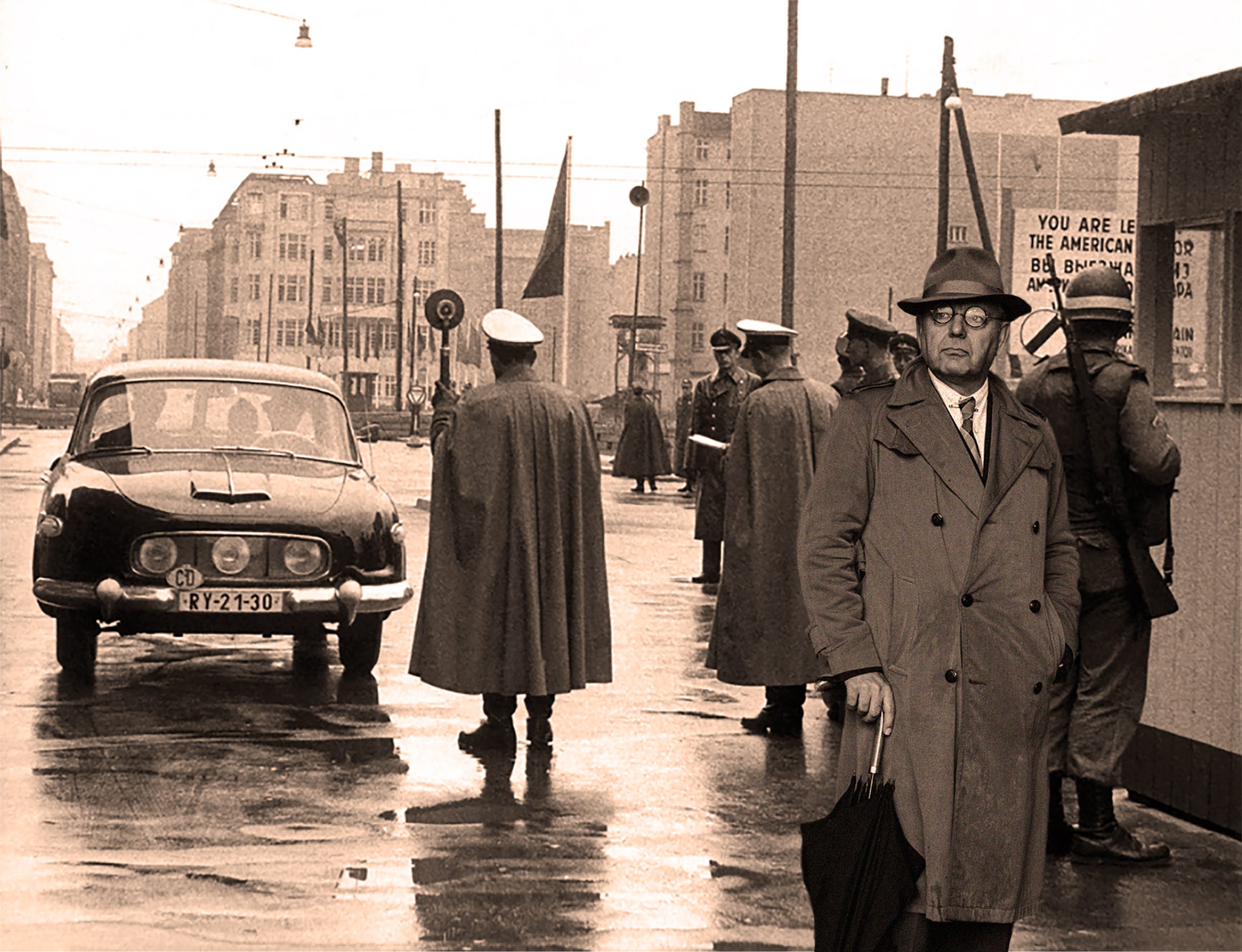
The most striking thing about August Hanning, the former German intelligence chief arrested this week on suspicion of betraying state secrets, is how un-spy-like he was.
I ran into Hanning several times over the years on the European circuit of foreign policy fora: Munich, Bratislava, Riga, Berlin.
Unlike other practitioners of the dark arts I’ve dealt with, Hanning was always extremely eager to talk, and even more eager to please, readily offering, in no particular order, his opinion, calling card, and a promise to help.
In that sense, he was typical of the former senior official who, unshackled by the constraints of the civil service, wants the world to finally understand what a big deal he was (and to engage his services). Even so, for a former intelligence chief, Hanning was unusually chatty and enthusiastic about speaking to journalists.
But then Hanning wasn’t a real spy. Like most senior German officials stretching back to the Bismarck era, Hanning studied law before entering the civil service.
His big break came in 1986, when he was posted to East Berlin, where he was responsible for negotiating the release of GDR dissidents who wanted to flee to the West. That experience gave him entrée into the world of espionage and, by the early 1990s, he had become a senior player in Germany’s intelligence apparatus. In 1998, Chancellor Gerhard Schröder appointed him president of the BND, Germany’s foreign intelligence agency.
The man who helped sell the Iraq war
It was on Hanning’s watch that Mohammed Atta, an Egyptian who had studied in Germany, and his Hamburg cell of Islamic extremists prepared for and carried out the 11 September terrorist attacks in the US.
While the BND managed to shift much of the blame for that fiasco to Germany’s domestic intelligence service, there was no denying its central role in the next big failure. His name, somewhat prophetically, was Agent Curveball.
Curveball, whose real name was Rafid Ahmed Alwan al-Janabi, was an Iraqi who arrived in Germany in 1999, claiming to have worked as a chemical engineer on a secret, mobile biological weapons programme for Saddam Hussein. The Germans interviewed him for months and passed on his testimony to the CIA.
By late 2002, as the US prepared its case for war against Iraq, Curveball had become a star witness for the claim that Saddam was brewing weapons of mass destruction. So much so that the CIA asked the BND if it could arrange for an American television network to interview him.
Hanning refused. Indeed, he wouldn’t even let the CIA interview Curveball. Years later, CBS’s 60 Minutes programme reported that then-CIA director George Tenet had made an urgent request for access to Curveball in December 2002 and was turned down by Hanning.
The German did give the US permission to publicly disclose Curveball’s claims, as long as his identity was protected. In a letter to Tenet, Hanning described Curveball’s testimony as “plausible and believable”, while also stressing that attempts to verify it had been unsuccessful and that his reports “must be considered unconfirmed”. Tenet later said he hadn’t seen the letter.
Either way, in early February 2003, Curveball’s claims featured prominently in Secretary of State Colin Powell’s presentation on Iraq’s alleged weapons of mass destruction to the UN Security Council.
“The source was an eyewitness, an Iraqi chemical engineer, who supervised one of these facilities. He actually was present during biological agent production runs. He was also at the site when an accident occurred in 1998. Twelve technicians died from exposure to biological agents,” Powell said.
Six weeks later, the US invaded Iraq.
By the time Hanning stepped down as BND president in 2005, Curveball’s story had been thoroughly discredited. Berlin, which had defiantly refused to join the US in the war, blamed the CIA, stressing that the BND had cautioned that Curveball’s claims couldn’t be verified.
Hanning, meanwhile, continued his rise through Germany’s state apparatus, becoming state secretary at the Interior Ministry under Wolfgang Schäuble, at the time arguably Germany’s most powerful politician after Angela Merkel. Effectively a deputy minister, Hanning had a wide brief, overseeing counterintelligence, the federal police, international intelligence cooperation and migration management.
Hanning was forced into early retirement in 2009 by Schäuble’s successor, who reportedly objected to his management style. Thus began his foray into the private sector, where Hanning worked as a security consultant and, prosecutors allege, used classified intelligence for the benefit of foreign interests. Hanning denies any wrongdoing.
The decision by a German court this week to remand Hanning, 80, in custody suggests that prosecutors have assembled substantial evidence against him. (You’ll find a good rundown of the case here.) Under German law, pre-trial detention requires a high degree of suspicion, as well as grounds such as a risk of flight or interference with evidence.
That said, German authorities have a decidedly mixed record in pursuing such cases. A recent example involved the former EU ambassador Gerhard Sabathil, who was suspected of secretly working for China. He was placed under electronic surveillance for more than a year before police raided his residence at dawn and took him in for questioning.
Details of his case leaked to the media, doing irreparable harm to his reputation. The investigation was dropped within months, however, and he was never charged.
More recently, allegations of Russian intelligence connections cost Germany’s former cybersecurity chief, Arne Schönbohm, his job, only for a Munich court to rule in June that claims he had knowingly maintained contacts with Russian intelligence were false.
A Nazi pedigree
To really understand the problems with German intelligence, however, you have to go back to the beginning.
For obvious reasons, the Western allies weren’t enthusiastic about allowing West Germany to build an intelligence service after the Second World War. At the same time, the US was keen to tap German knowledge about the West’s new archenemy: the Soviet Union.
After the war, US Army intelligence recruited Reinhard Gehlen, a German general who had led the Wehrmacht’s intelligence operations targeting the Soviets. Under US supervision, Gehlen built a new intelligence service, known as the Gehlen Organisation. Gehlen relied heavily on former SS officers and other ex-Nazi officials to establish the service, which in 1956 became the BND. Gehlen, who had served Hitler’s regime, was its first president.
It didn’t go well. In 1961, it turned out that one of Gehlen’s key men, former SS officer Heinz Felfe, was really working for the KGB. Felfe, who was responsible for counterintelligence, compromised numerous agents. He was convicted of treason in 1963.
In retrospect, relying on a motley crew of ex-Nazis to build Germany’s postwar intelligence apparatus was a mistake (who knew?), if for no other reason than the service struggled to develop a culture grounded in professional integrity and institutional accountability.
During the Cold War, the BND, then headquartered near Munich, was largely a junior partner to American intelligence. Though it ran agents behind the Iron Curtain, its resources and operational reach were limited compared with those of the CIA or Britain’s MI6. The Germans were adept at analysing Soviet military capabilities but struggled with more sophisticated espionage operations, a weakness that would haunt the service for decades.
By the time Hanning took over the BND, it had become another big, plodding German bureaucracy, ill-equipped to deal with the challenges the country faced. Even some of Germany’s most celebrated counterterrorism successes depended on foreign intelligence. In 2007, for example, German authorities foiled a plot by Islamist militants to bomb American military installations, but only after receiving a crucial tip from US intelligence.
One of the BND’s biggest undertakings was its move from Bavaria to Berlin, a project Hanning had set in motion. In 2011, confidential building plans went missing, raising fears that foreign intelligence services might exploit the security breach to penetrate the new headquarters before it even opened. Four years later, the BND suffered another embarrassment when thieves removed several water taps during construction, causing extensive flooding.
The BND’s shortcomings were on vivid display during the chaotic Western withdrawal from Afghanistan in August 2021. Just two days before Kabul fell to the Taliban, German intelligence was still assessing an imminent collapse as unlikely, contributing to Berlin’s failure to evacuate German nationals and Afghan employees in time. A subsequent parliamentary inquiry found that bureaucratic inertia and poor coordination compounded the intelligence failure, leaving thousands scrambling to escape as the Taliban swept into the capital.
The spy who got stranded
Just months later, the BND suffered another humiliation when its then-president, Bruno Kahl, flew to Kyiv just hours before Russia’s full-scale invasion of Ukraine.
Despite warnings from American and British intelligence that an attack was imminent, Kahl reportedly declined to join an emergency evacuation of German diplomats, preferring to keep his appointments with Ukrainian intelligence officials. Those meetings never took place. Instead, Germany’s top spy found himself stranded in a war zone and had to be evacuated overland.
In December of that year, Kahl suffered another setback when one of his officers, identified as Carsten L., was arrested on suspicion of spying for Russia. The senior official, who denies the allegations, worked in the agency’s signals intelligence division and stands accused of passing classified information to Russian intelligence, including material obtained from Western allies, in exchange for money.
That history illustrates why breathless claims in the German media and elsewhere in recent days that the Hanning case “puts the integrity of German intelligence in question”, as Der Spiegel wrote, are laughable. The BND’s credibility has been in doubt since its founding.
Despite that low bar, the timing of Hanning’s arrest was particularly awkward. Just days earlier, the German parliament had begun debating government plans to broaden the BND’s purview, including new authority to access the computer systems of hostile actors and strengthen its cyber-intelligence capabilities.
Perhaps before giving the BND more powers, Berlin should consider a more fundamental reform: putting real spies in charge.
The Week Ahead | 12–18 October
Europe’s leaders gather in Brussels this week with an agenda that reads like a catalogue of the continent’s anxieties: a struggling economy, expensive energy, Russian aggression, Chinese competition and an increasingly unaffordable list of political ambitions.
The €2 trillion question. At their summit on Thursday and Friday, EU leaders will confront the bloc’s next seven-year budget. The Commission wants roughly €2 trillion to finance everything from defence to agriculture. Several northern European governments are demanding restraint. The problem for Brussels is that almost everyone wants Europe to do more, but few are volunteering to pay for it.
China’s European problem. The summit will also take stock of the EU’s deteriorating trade relationship with Beijing. Trade Commissioner Maroš Šefčovič has been pressing China to address a goods trade imbalance exceeding €1 billion a day. The question now is whether Europe has the political stomach to do anything about it.
Russia on the doorstep. European leaders will discuss Ukraine’s needs ahead of another winter of Russian attacks, alongside Moscow’s hybrid operations inside the EU. Expect plenty of talk about European defence readiness. The more interesting question is whether governments are prepared to turn their promises into capabilities.
Brussels warms up. Before the leaders arrive, foreign ministers meet on Monday to discuss Ukraine and the Middle East, while European affairs ministers gather on Tuesday to prepare the summit and wrangle over the budget. The real negotiations will begin well before Thursday.
The global economic reality check. Meanwhile, the IMF and World Bank hold their annual meetings in Bangkok from Monday through Sunday. With Europe’s competitiveness woes dominating the Brussels agenda, the latest assessment of the world economy will make for instructive reading.